HINEC at the 2025 KSIAM Annual Meeting, Gyeongju
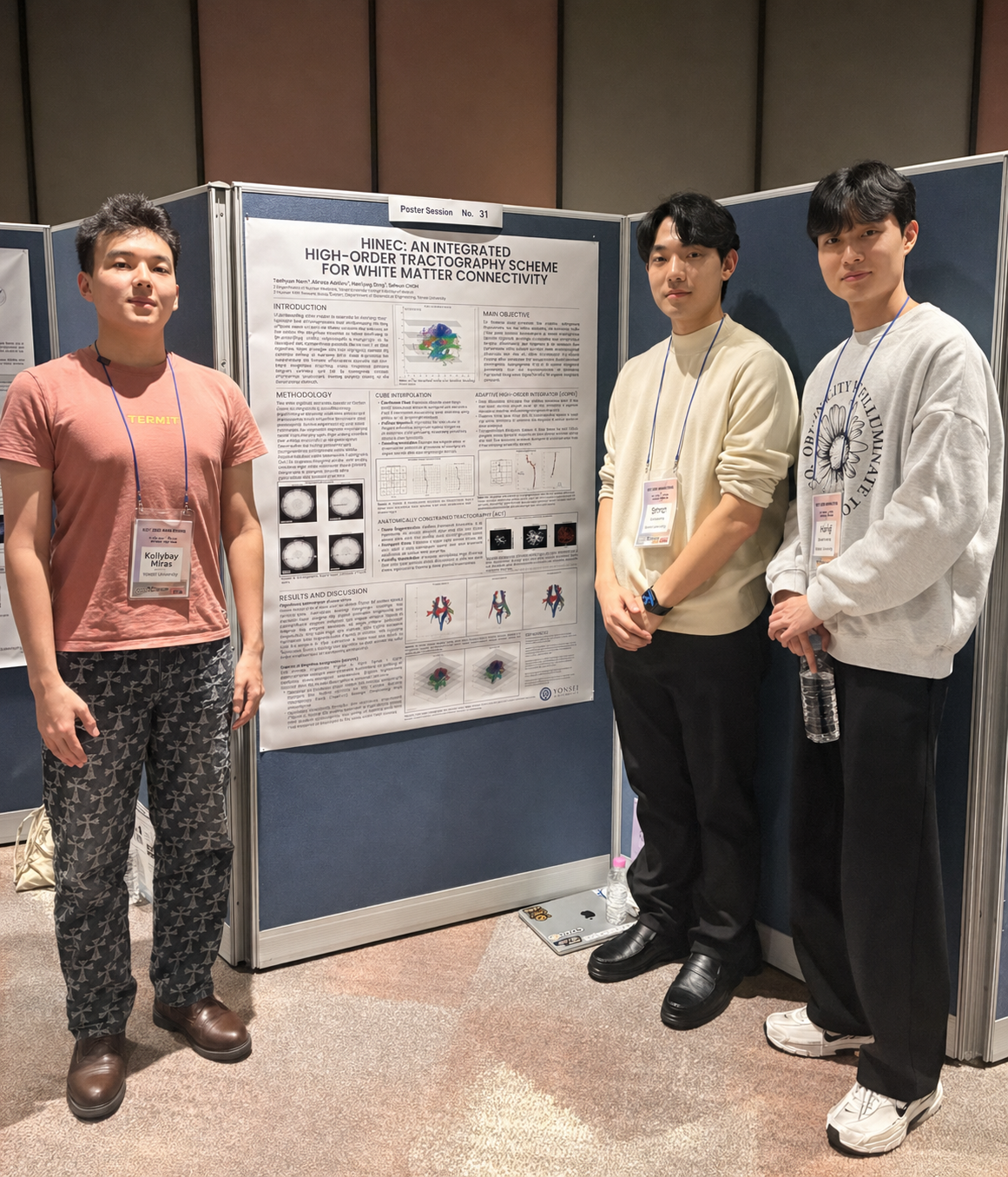
Miras Koilybay, Taehyun Han, and Woosung Choi presenting HINEC at the poster session
Members of the HINEC Lab at Yonsei University attended the 2025 KSIAM Annual Meeting, held November 27–28 in Gyeongju, South Korea at the BCHC Cafe conference center. KSIAM — the Korean Society for Industrial and Applied Mathematics — brings together researchers from across Korea working at the intersection of mathematics and real-world applications.
HINEC presented a poster titled "HINEC: An Integrated High-Order Tractography Scheme for White Matter Connectivity", introducing our pipeline's core advances: the Continuous Field (CF) framework for multi-voxel interpolation, DOFRIS (Direction-Optimized Fiber Reconstruction with Integrated Seeding), and Anatomically Constrained Tractography (ACT) — together forming a tractography system that significantly reduces false-positive streamlines and improves anatomical fidelity.
The work demonstrates how combining higher-order integration with biologically-constrained seeding leads to substantially more accurate white matter mapping compared to conventional deterministic and probabilistic methods, with validation against the ISMRM 2015 Tractography Challenge dataset.
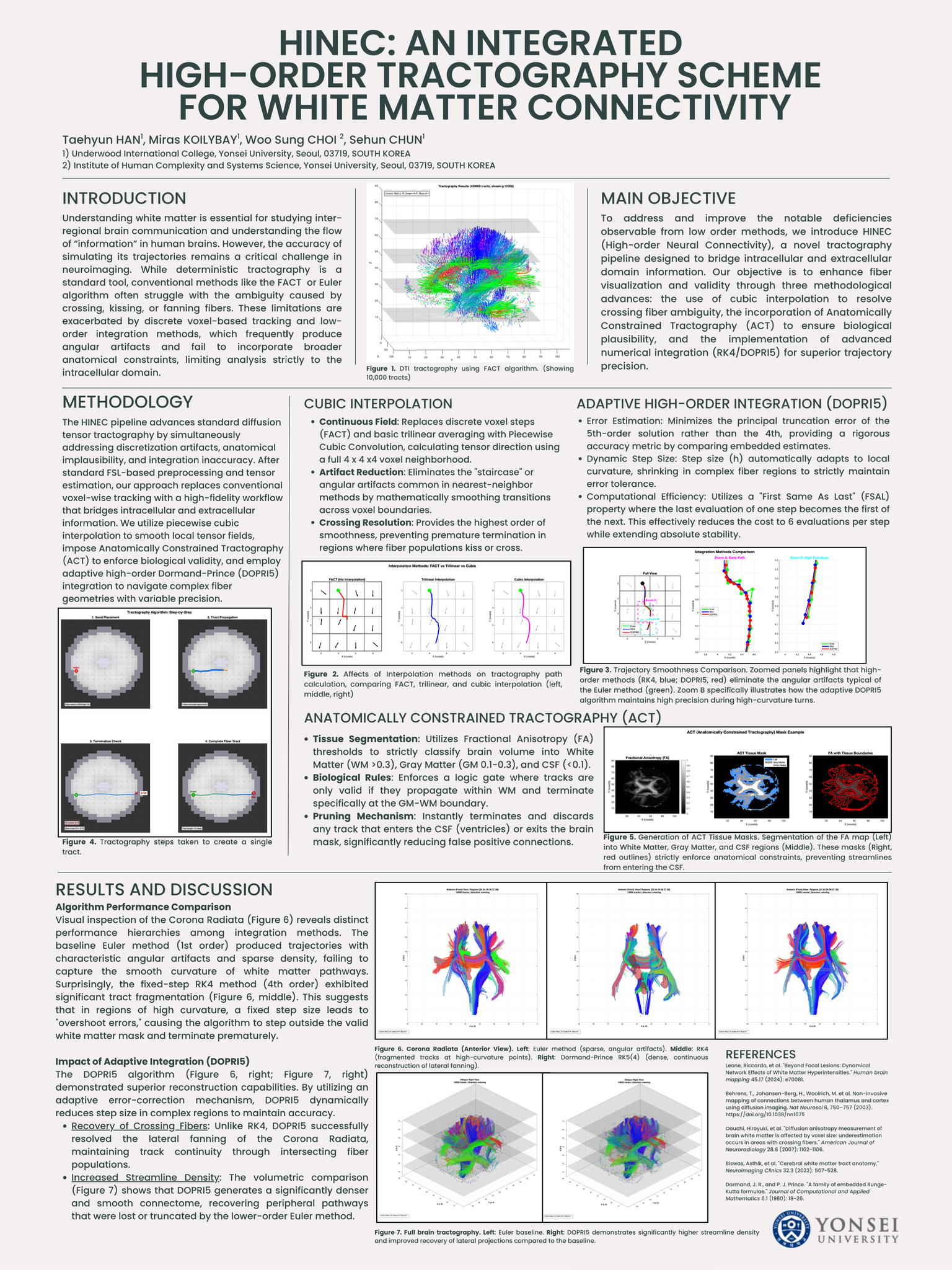
Conference poster — click to enlarge
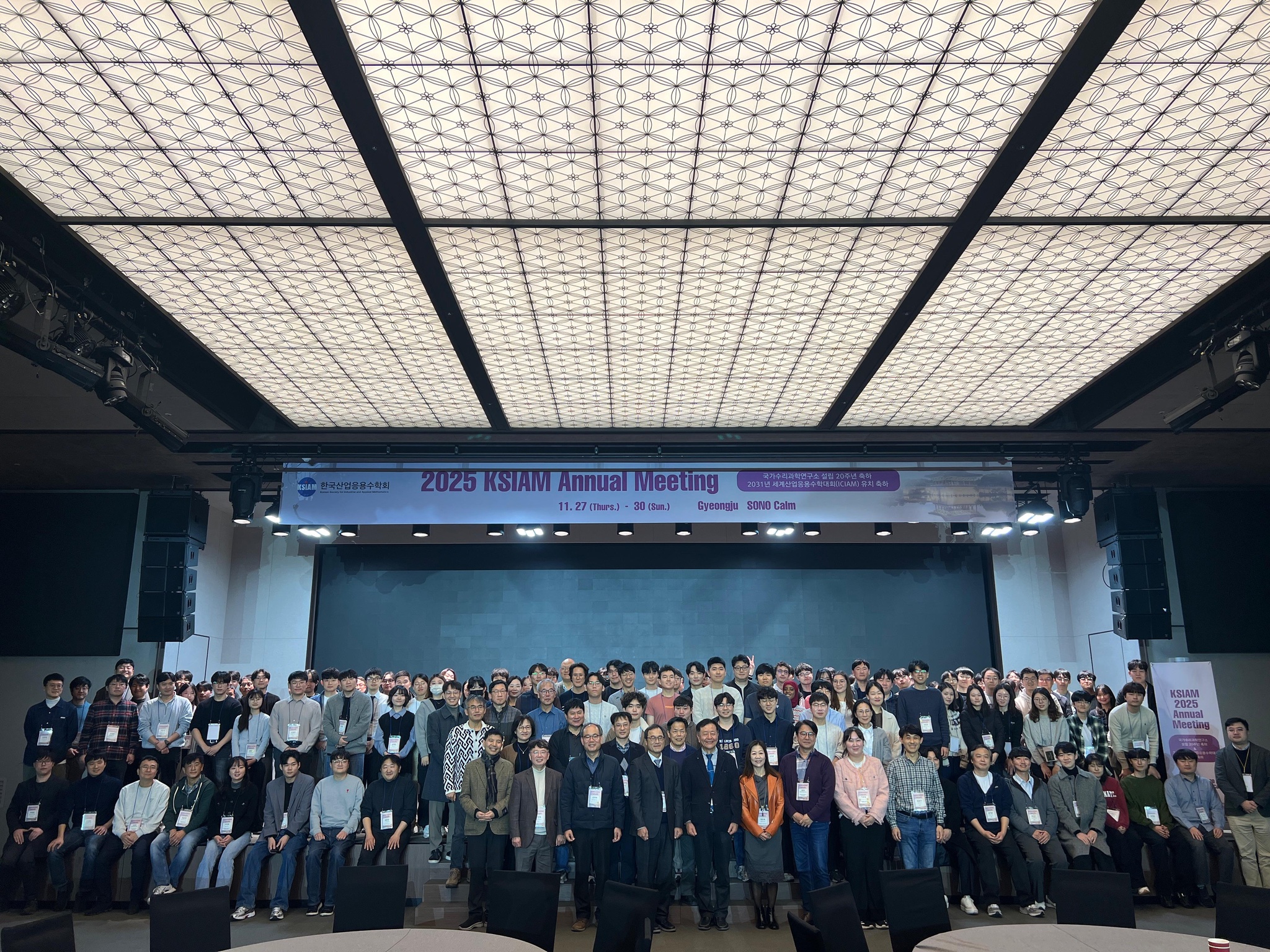
Group photo — 2025 KSIAM Annual Meeting
Key contributions presented
- Continuous Field (CF) Framework — Replaces discrete voxel steps with continuous trilinear or Perona–Malik interpolation, enabling smoother tract reconstruction across crossing and fanning regions.
- DOFRIS — High-Order Integration — Adaptive Dormand–Prince RK45 integration minimises local discretisation error. Dynamic step sizing adjusts to local curvature, reducing false-positive connections at tight bends.
- Anatomically Constrained Tractography (ACT) — Biologically-informed seeding restricts streamlines to WM/GM interfaces and uses tissue-type maps to terminate or reject anatomically implausible paths.
- ISMRM 2015 Benchmark Validation — HINEC achieves significantly higher valid connection rates and lower false positives vs standard deterministic/probabilistic methods across the challenge phantom.