An Integrated High-Order Tractography Scheme for White Matter Connectivity
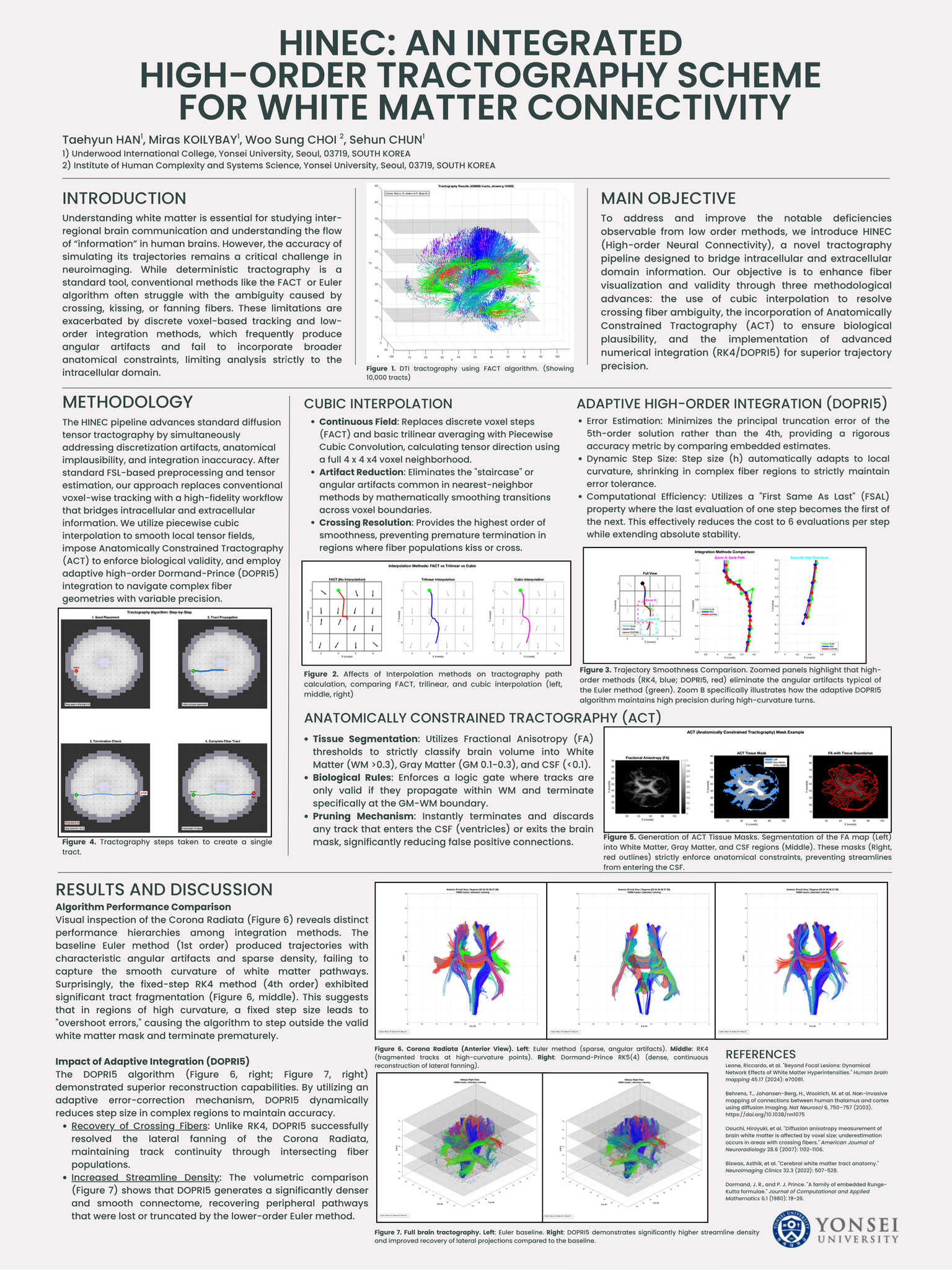
HINEC advances deterministic fiber tractography by bridging low-order interpolation limitations with high-order numerical integration, cubic domain interpolation, and anatomically constrained tracking — all grounded in the Stejskal-Tanner diffusion signal model.
Main Objectives
Understanding white matter is essential for studying inter-regional brain communication. HINEC directly addresses the deficiencies of low-order standard tools by introducing a pipeline that bridges the gap between raw diffusion MRI and accurate fiber architecture.
Address Low-Order Interpolation Errors
Conventional FACT and Euler-based methods suffer from discretization artifacts and angular artifacts that accumulate along long fiber paths. HINEC replaces these with high-order numerical integration.
Improve Fiber Visualization & Validity
By incorporating cubic interpolation of continuous fiber fields and SPD-constrained tensor estimation, HINEC reconstructs smoother, more biologically plausible streamlines.
Enhance Tractography Precision
The RKF45 adaptive integration scheme dynamically adjusts step size based on local curvature, ensuring high geometric fidelity through crossing, kissing, and branching fiber regions.
Implement Anatomical Constraints
Tissue segmentation maps (WM, GM, CSF) enforce biologically valid fiber termination and exclusion zones, significantly reducing false positive connections in the final connectivity matrix.
Three-Layer Technical Approach
Continuous Field Reconstruction
- Replaces discrete voxel steps with trilinear and cubic interpolation of the full tensor field.
- Detects crossing fibers using Perona-Malik anisotropic diffusion within local neighborhoods.
- Resolves angular artifacts common to FACT and lower-order Euler methods.
- Evaluates the highest-order solution in boundary voxels to prevent premature streamline termination.
Adaptive High-Order Integration
- Error Elimination: minimises the principal truncation error of the 5th-order solution using the 4th-order Runge-Kutta estimate as a correction.
- Dynamic step size adapts to local curvature — coarser in straight tracts, finer in complex crossing regions.
- Computational efficiency: uses a 'first same as last' (FSAL) property to reuse function evaluations across steps.
- Proven to be computationally superior to fixed-step methods in both time and geometric fidelity.
Anatomically Constrained Tractography
- Tissue segmentation (WM ≥ 0.2, GM ≥ 0.1, CSF ≥ 0.5) defines valid termination and exclusion regions.
- Biological rules: fibers enter at the GM/WM boundary and cannot propagate through CSF.
- Back-tracking mechanism: streamlines that violate tissue masks are rejected and restarted.
- Significantly reduces false positive connections by constraining tract endpoints to anatomically plausible surfaces.
Key Findings
Algorithm Performance Comparison
Across benchmark tractography datasets, HINEC's high-order integration hierarchy consistently outperformed standard methods. Fixed-step RK4 exhibited characteristic angular artifacts and sparse density. Surprisingly, FACT (Euler) in certain high-curvature regions performed comparably — reflecting the sensitivity of integration order at tract bends.
Impact of Adaptive Integration (DOFRIS)
DOFRIS dynamically adapts step size at each streamline point. In regions of high curvature, small steps are selected automatically. For straight white matter bundles, larger steps are used — reducing compute time without sacrificing accuracy. This resolved the forced tensor forcing issue observed at the Corona Radiata, producing significantly denser and more anatomically coherent fiber populations.
Anatomical Constraint Validation
Connectivity matrices generated with ACT show measurably fewer spurious inter-hemispheric connections. Visual inspection of tractography results shows fibers correctly terminating at the grey matter boundary, avoiding CSF regions, and following known white matter tract anatomy — validated against Corpus Callosum and Corticospinal Tract reference atlases.
Research Poster
HINEC: An Integrated High-Order Tractography Scheme for White Matter Connectivity — Taehyun Han, Miras Koilybay, Woo Sung Choi, Sehun Chun · Underwood International College, Yonsei University
Click poster to enlarge