HINEC
A neuroscience pipeline for turning diffusion MRI data into understandable maps of brain connectivity.
Built for white matter tractography, reproducible research, and high-order neural connectivity analysis.
What does HINEC actually do?
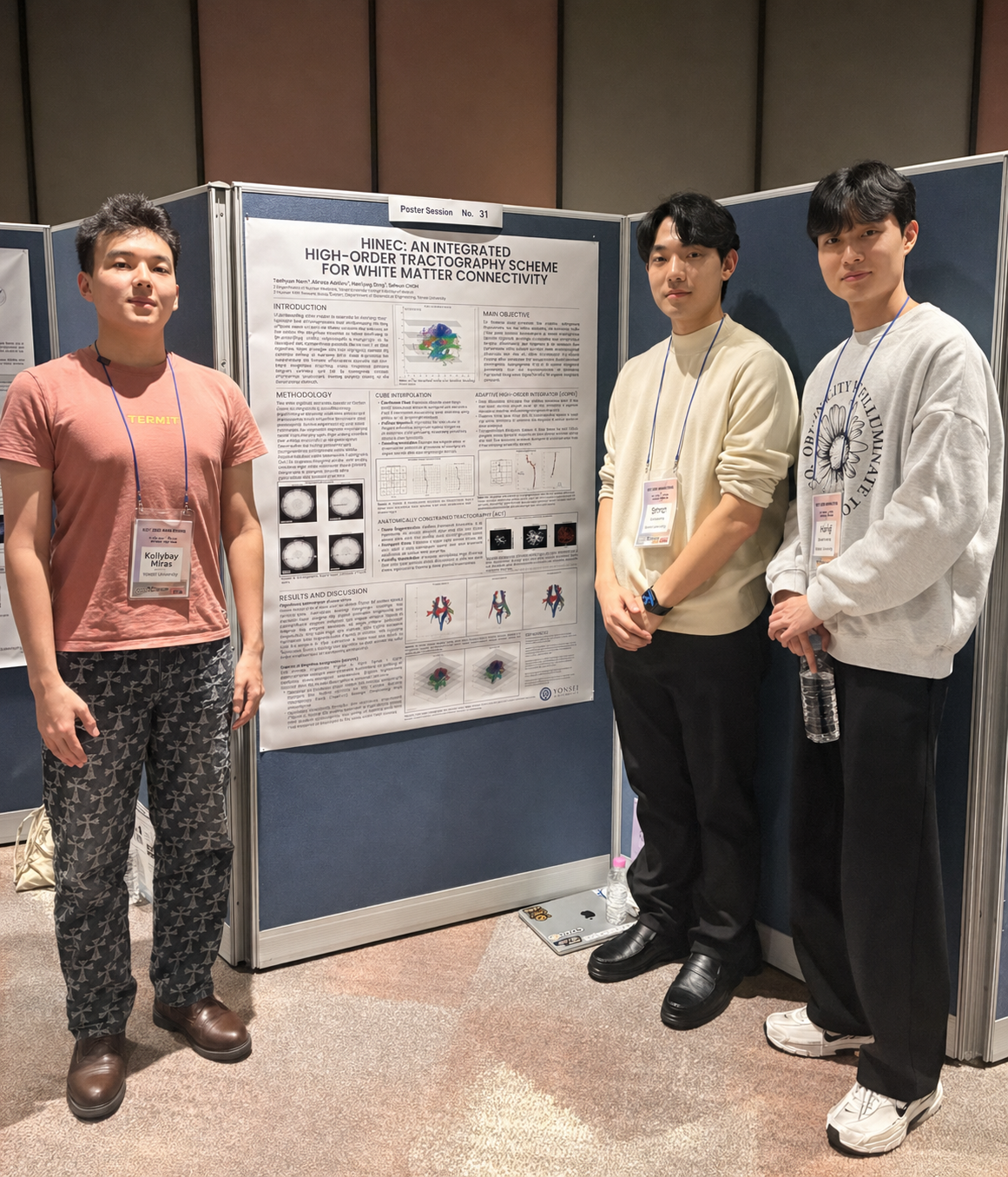
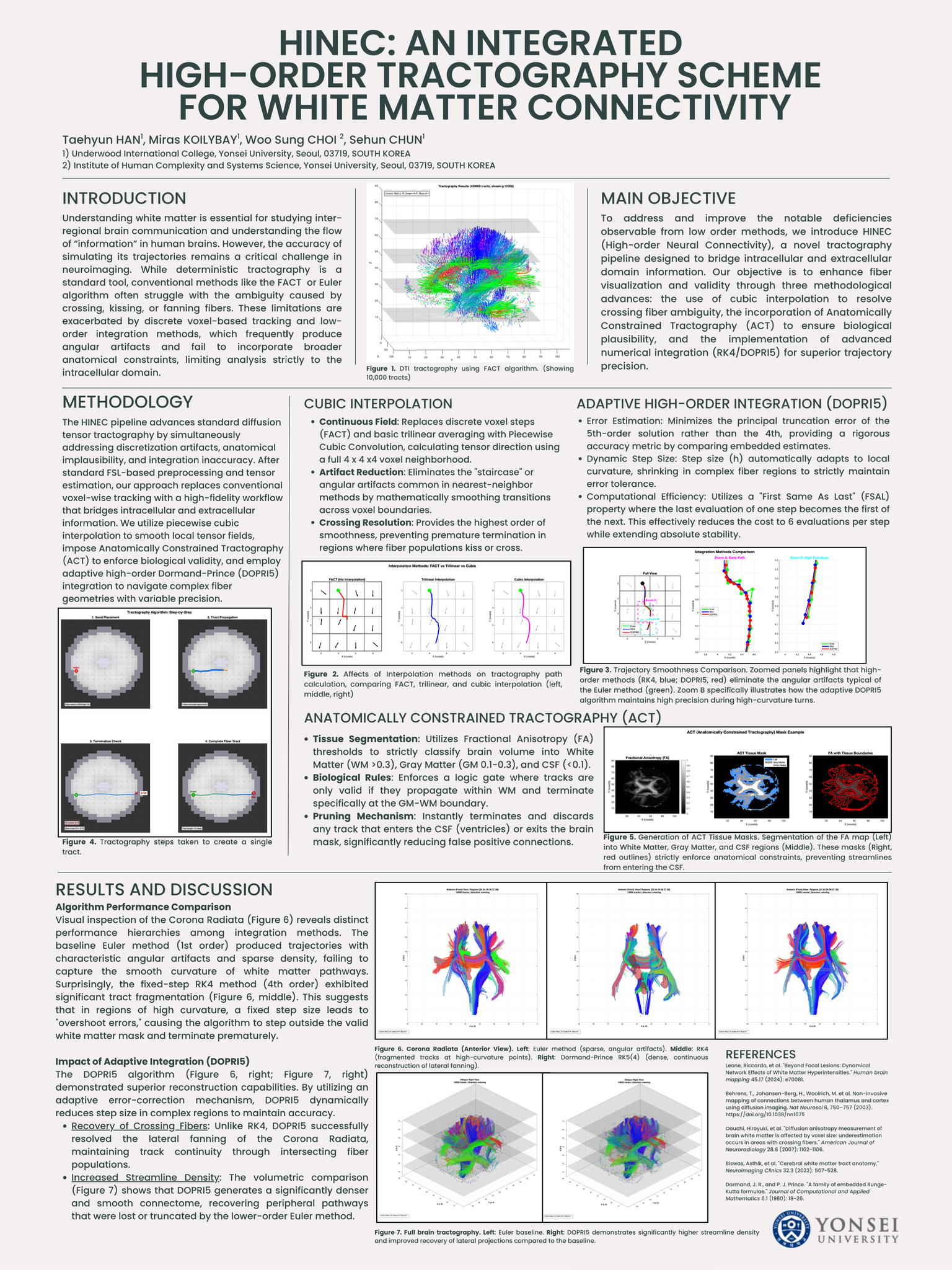
HINEC takes a type of brain scan called diffusion MRI and uses it to estimate how water moves through brain tissue. Because water tends to move along white matter fibers, the pipeline can reconstruct possible pathways that connect different regions of the brain.
Diffusion MRI Data
Start with a raw brain scan that measures how water moves through tissue.
NIfTI format with b-values and b-vectors
Clean & Correct
Remove noise, correct for motion, magnetic field distortions, and eddy currents.
FSL-based 10-step preprocessing pipeline
Estimate Tensors
Compute a 3D diffusion model at every point in the brain.
SPD-constrained log-linear tensor fitting
Compute FA Maps
Measure how directional the diffusion is at each location.
Fractional anisotropy from eigenvalues
Parcellate Regions
Identify and label different brain regions using standard atlases.
MNI-to-DWI atlas registration via T1
Track & Visualize
Reconstruct and render white matter pathways connecting brain regions.
FACT, RK4, RKF45 integration + 3D visualization
Why Brain Connectivity Matters
The brain is not only a collection of regions. It is a connected system. White matter pathways act like communication routes between regions — carrying signals that enable perception, movement, thought, and consciousness.
HINEC helps researchers study those routes by converting complex imaging data into tractography, connectivity matrices, and visualization outputs. Understanding these pathways is fundamental to neuroscience, neurology, and computational brain science.
Explore the mathematical foundationsFrom Raw Scan to Neural Pathways
Research Focus
Moving frames, curvature tensors, high-order computational schemes applied to neural and cardiac signal propagation in multidimensional spacetime domains.
Affiliation
Underwood International College, Yonsei University
Adjunct Faculty, Artificial Intelligence, POSTECH
The HINEC Pipeline
From raw NIfTI diffusion MRI files to reconstructed white matter fiber tracts, configured through a single YAML parameter file.
Preprocessing
B0 extraction, T1-enhanced brain masking, MP-PCA denoising, FUGUE distortion correction, and FSL eddy current removal.
Learn moreTensor Estimation
SPD-constrained diffusion tensor fitting from the Stejskal-Tanner equation. Computes FA, MD, and principal eigenvector maps.
Learn moreFiber Tracking
Three algorithms: FACT (Euler), RK4 (4th-order Runge-Kutta), and adaptive RKF45 with anatomically constrained tractography.
Learn moreParcellation & Visualization
MNI-to-DWI atlas registration, region labeling, connectivity matrix generation, and 3D fiber visualization.
Learn moreQuick Start
Run the complete pipeline with a single command. Choose your speed-quality tradeoff with configuration presets.
./bin/run_hinec.sh data/parcellation_sample/sample sample.matSee the full getting started guide for installation, prerequisites, and configuration details.
For Different Audiences
For Students
Understand how brain connectivity can be reconstructed from diffusion MRI. Explore the theory, see the math, and run example pipelines.
Get startedFor Researchers
Run reproducible tractography experiments with configurable preprocessing, tensor estimation, tracking algorithms, and visualization.
Get startedFor Developers
Explore the MATLAB function architecture, YAML configuration system, visualization modules, and validation extensions.
Get startedResearch-Grade, But Usable
Advance Neuroscience Research
Your contribution directly funds the development of open-source diffusion MRI tools, student fellowships, and computational infrastructure at Yonsei University.
Synapse
Support foundational research operations and student fellowships.
Cortex
Fund a specific research initiative or equipment acquisition.
Connectome
Sponsor a full research project with named recognition.